
The best employee gift isn’t for your employee.
It’s for their family. Totem is a card game where each person hears the people around them say what they see best in them. The gift comes from you. The evening belongs to them.

You may not have heard of Totem. 350,000 households have.

This is Totem
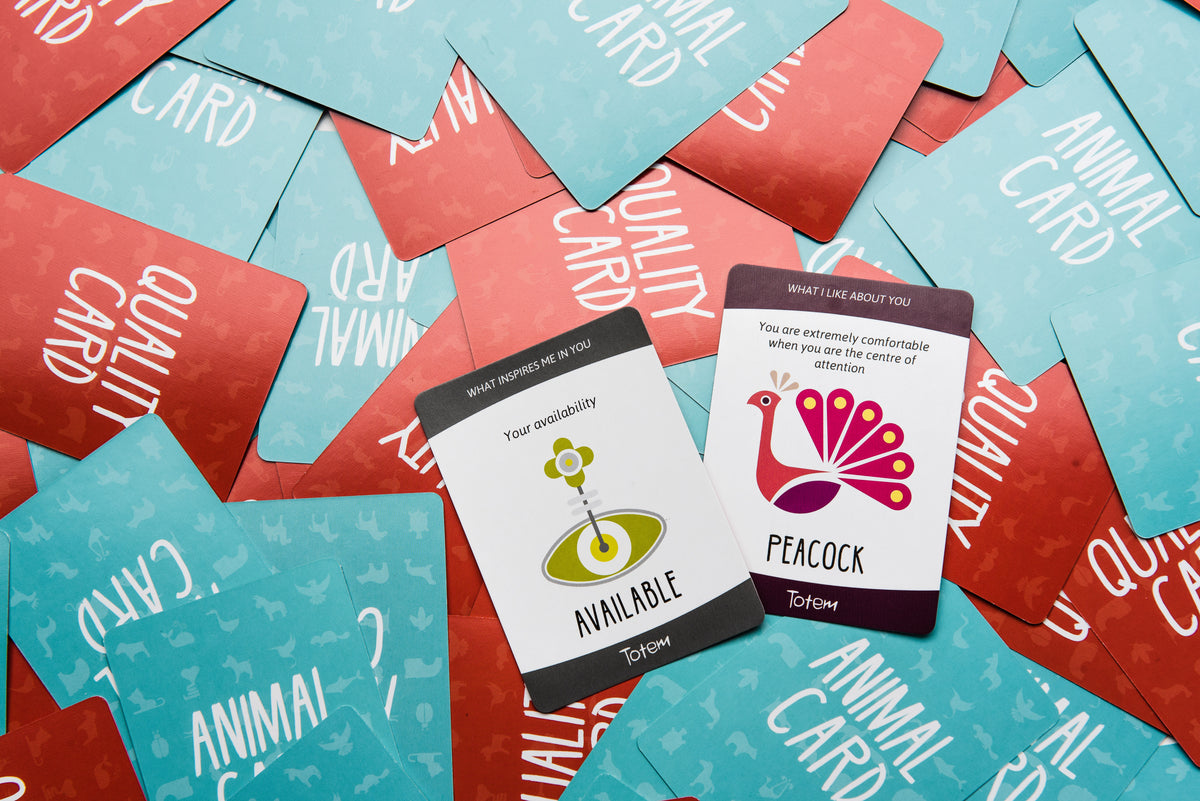
80 Animal cards, 80 Quality cards. For each person in turn, everyone else picks one card from each, then says out loud why. The Animal card and the Quality card that rank highest become that person’s totem.
On paper the mechanic is simple. At the table, nobody is ready to hear all of it at once.


160 cards · 3 to 8 players · ages 8 and up · 20 to 30 minutes per person
Do the math on last year’s gift.
Say you have 500 people. Say you spent $25 a head.
That’s $12,500.
Now answer three questions honestly:
How many of those gifts are still being used today?
How many got mentioned at home that night?
How many did an employee’s child ever touch?
Right.
That’s not a budget problem. That’s an aim problem. The gift landed on a desk. And a desk is where corporate gifts go to be forgotten.

Six years on the same account, and this year they recommended Totem.
There’s a firm that designs and curates corporate gifts for a living. Part of its mandate is recommending the right game for the right group of people.
For six years running, it has built the Christmas gift for the children of employees at one of the largest private companies in Latin America, a company with more than 10,000 employees.
Every year has a theme. This year the program is built on Gardner’s theory of multiple intelligences. The children are split into six age groups, and each group receives a gift aimed at a different set of intelligences.
The ten-to-twelve-year-olds got interpersonal and intrapersonal intelligence. For them, the firm recommended Totem. 3,000 copies, as the centrepiece of that age group’s package.
Read that back.
People who are not allowed to get this wrong, who have to hold the attention of children old enough to see straight through anything that isn’t real, and who have to defend their choice to a client they have kept for six years: those are the people who recommended Totem.
And then the game ends up in the employee’s hands. Think about what happens next.
He carries the package home in December. His daughter opens it, because kids open boxes. They play it that evening, because it needs nothing but a table and the people already in the room. And somewhere in that half hour, an eleven-year-old hears her father say out loud, with details and an example, what he admires about her.
That is not a gift card moment.
And the employee knows exactly who put that evening in his hands.
So what is Totem?
It’s simple.
A small box. 160 cards. 80 animals, 80 qualities. Three to eight players, ages 8 and up. About 20 to 30 minutes per person receiving their totem.
One person becomes the receiver. Everyone else picks the Animal card and the Quality card they think fit that person best.
The cards are shuffled together, so the receiver has no idea who chose what.
The receiver ranks them, before a single word of explanation.
Then, one by one, everyone says out loud why they picked the card they picked. And the receiver doesn’t get to speak. No “oh stop.” No jokes to cover the discomfort. Nothing to do but sit there and take the wave of love. At the very end, they get one word: “Thank you.”
The top-ranked animal and the top-ranked quality become that person’s totem. Faithful Owl. Courageous Ram. Comforting Tiger.
Then the spotlight moves, and somebody else gets their turn.
No points. Nobody gets eliminated. Everybody wins, which sounds like a slogan until you live it.
Step four is the one people aren’t ready for.
Being told one nice thing is easy to deflect. Most of us are experts at it. We laugh, we change the subject, we hand the compliment back.
Totem takes that away. You can’t speak. And they keep going. One after another, everyone in the room tells you something true and good about you and then explains exactly why they believe it.
That’s the half hour people describe afterwards as tears, laughter, and a kind of surprise: the surprise of finding out how much the people around you had noticed and never said out loud.
And step three is why it lands. Because the receiver ranks the cards before hearing the other players’ reasoning, they can’t be polite about it. They’re simply picking what rings true about themselves. Then the explanations arrive and either confirm it or surprise them.
That order is the whole difference between being flattered and feeling seen.
80 animals × 80 qualities = 6,400 possible totems. No two rounds land the same way.
The facts you can put in an email to your boss
If your boss wants more than a good story, this is what he needs.
What it trains
Gardner’s framework separates two kinds of intelligence: interpersonal, which is reading and relating to other people, and intrapersonal, which is knowing yourself. Totem exercises both at once, and it’s hard to do one without the other. To choose a card for someone you must have observed them precisely enough to characterize them, then explain your choice out loud. To rank the cards handed to you, you must recognize yourself in them.
Peer-reviewed research
The Totem method has been studied in the European Journal of Work and Organizational Psychology (2026). The study looked at Totem’s digital version in a workplace setting, measuring employee well-being and perceived team effectiveness. The verdict: a positive effect still measurable three weeks later.
Gradito Dubord, M.-A. et al. (2026) ‘Finding your Totem: unveiling the effects of a positive technology intervention on employees’ well-being and perceived team effectiveness with self-determination theory’, European Journal of Work and Organizational Psychology, 35(3), pp. 321–341. doi: 10.1080/1359432X.2025.2566811Used by professionals
Beyond families and friends, Totem’s reviews are signed by coaches, managers, therapists, school counselors and social workers. Nobody asked them what they do for a living. They volunteered it while describing what the game did in the room.
Now here’s the part that matters to you
Every brand on earth is trying to buy an association with a feeling.
That’s what sponsorship is. That’s what most advertising is. You rent proximity to a moment people love, and you hope some of it rubs off on your name.
You’re not renting anything here. You’re the one providing the experience.
Your name is on the box that produces the moment. Not beside it. On it.
And it doesn’t happen once. The box goes in the cupboard by the board games. It comes out at Christmas. At the cottage. The night the cousins are over. The rainy Sunday when nobody can agree on a movie.
Every single time: the same feeling in the room, and the same name on the lid.

There is no media buy that does that. You can’t purchase thirty seconds inside someone’s family evening.
That’s what the 1,000-unit branded run actually is.
Below that, you’re giving a very good gift. At 1,000, you’re buying an association nobody can outbid you for, in a room no advertiser can reach.
Ready for a number?
Tell us how many and we’ll come back with a per-unit price and a lead time. Nothing else happens until you ask for it.
Get bulk pricing4 questions. Under a minute.
Three reasons it outperforms anything in the catalog
It reaches the household, not the desk
Most corporate gifts are used alone, at work, by one person. This one gets opened at a table with everyone the employee actually cares about in the room. You’re not giving them an object. You’re giving them evenings with the people closest to them. Not many line items on a gift budget can say that.
It survives
A hamper is gone in a week. A jacket ends up mowing the lawn. Totem is still in the cupboard in four years. And so is your name.
Your employee gets to be the hero
The company gives, the employee delivers, the family remembers. Credit flows in both directions, which is more than most gift budgets can claim.
Your employer brand usually stops at the office door. This one carries well beyond it.
350,000 games sold. 33 countries.
Here’s what people say after they play it.
My family (adults and teens) agreed to “humor mom” and play my new game, Totem, at Thanksgiving this year. Two hours later, after tears, laughter, and new-found respect for one another, we all had our totems. We agreed that we will play this game every year.
Even though we all knew each other, for months it still felt like two departments meeting together but without any bonding… Our plan was to do only one person due to time constraints. That absolutely did NOT happen. The VP announced we were scrapping everything else planned for the day and only concentrate on Totem. There were tears, sincere observations, meaningful bonding, unknown feelings shared and beautiful friendships formed.
He was able to articulate “I think you’re like a whale because even when I’m having a hard time you can be calm and help me through it.” I was BLOWN AWAY! … The kids keep asking to play the game every day and love to call each other by their given totem.
After the 100th fight had broken out I was beginning to think the vacation was doomed. Then my son pulled Totem out of my bag. We all decided to sit down and play a round before setting off for the day. It was the perfect call… Plus, the game provided us with fun nicknames to use for the rest of our vacation.
Love, Faithful Owl, Courageous Ram, Comforting Tiger and Charismatic Rabbit
A fun bonus was now having code words we can call ourselves based on the quality and animal cards chosen — Attentive Squirrel, Confident Parrot, Curious Dolphin. Our family loves to joke around so these code names were fun to laugh about.
I wanted something that wouldn’t be competitive… It really speaks love and life into one another and you finish feeling uplifted. We play anytime there is tension, strife, or when I just feel like we need to bond a bit more.
Is this right for you?
Probably yes, if
- You’re ordering 100 or more and you’d rather people feel something than file something
- A good share of your workforce has kids at home
- You’d rather be remembered than printed on
- You’re buying for the holidays, service anniversaries, family day, a wellness program, or onboarding kits
- You can plan two months ahead
Probably not, if
- You need boxes under your own brand next month. Branded runs take two months. Standard boxes ship much faster
- You’re hunting the lowest per-unit number that clears the budget line
- You need fewer than 100 units. Below that, just order from the store
Questions people ask before ordering
What’s the minimum order?
100 units. Each order is a single-language run: English, French, Spanish, or German. If you want the box produced under your own brand, the minimum is 1,000.
Can we put our company name on it?
Yes, at 1,000 units and up. Below that you choose the language, not the branding.
Can we see the game before we commit?
Yes. Ask for a sample in the form and we’ll send a single copy before you place an order. It does add time to the schedule, so if you’re working back from a December delivery, ask early.
What languages is it available in?
English, French, Spanish and German. In some cases we can adapt the game to another language. Tell us which one and we’ll come back with what that involves.
How long from order to delivery?
Two months from confirmed order. Plan accordingly. This is the one thing we can’t compress.
Can you ship to multiple sites, or straight to employees’ homes?
Yes to both. Multiple destinations are normal for us; tell us the split when we talk.
How long does it take to play?
About 20 to 30 minutes per person receiving their totem. Stop whenever you want and pick it up another night. Plenty of families do exactly that.
Is this a therapy tool? Will it feel awkward?
It’s used by therapists and school counselors, which is a good sign. But it was built as a game. Nobody is asked to share a feeling. You’re just explaining why you picked a card. That’s a much smaller ask, and it’s why kids play it without resistance.
What ages does it actually work for?
Ages 8 and up on the box. It plays best in a household with kids between roughly 9 and 16.
What does it cost?
Retail is $22.95. Bulk pricing depends on volume, language and destination. Tell us how many and we’ll send a number.
Want to hold one first?
Ask for a sample and we’ll send you a single copy before you commit to anything. It does add time to the schedule, so if you’re working back from a December delivery, ask early.
Get bulk pricingMention the sample in the message box.
Holiday orders close in October.
Production takes two months. Not a scarcity tactic. A printing schedule.
If these need to be in people’s hands before the holidays, the order has to be confirmed by mid-October. After that we’re shipping in the new year.
Tell us how many. We’ll send pricing.
A per-unit price and a lead time, within two business days. No call unless you ask for one.